
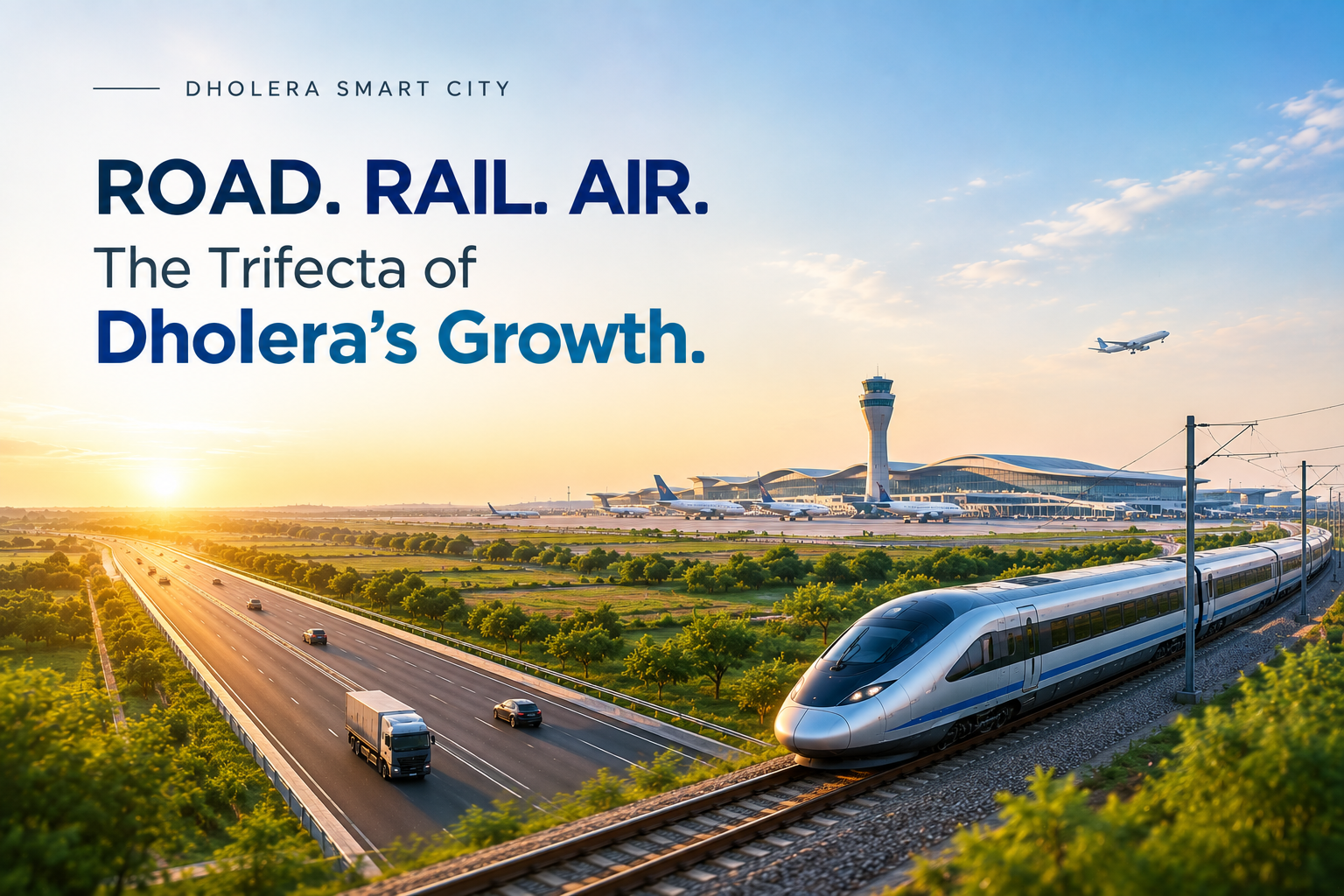
Dholera Smart City now has an airport, an expressway, and a railway on the way. No Indian smart city has ever had all three at once. Here is what that means for your investment.
Dholera Smart City now has an airport, an expressway, and a railway on the way. No Indian smart city has ever had all three at once. Here is what that means for your investment.
In January 2026, the Railway Administration confirmed that the Final Location Survey (FLS) for the proposed 65-km Bhavnagar–Dholera broad-gauge railway line is officially underway. The project was approved by the Union Government and Union Railway Minister Ashwini Vaishnaw personally reviewed the maps on-site and directed immediate action. Once the FLS is complete, a Detailed Project Report (DPR) will be submitted to the Railway Board, with construction expected to begin within 12–18 months of approval and complete within 36 months. The railway will serve both freight and passenger traffic, integrate with Bhavnagar Port (being developed as a multi-purpose container port), and complement the already-operational Ahmedabad–Dholera Expressway and Dholera International Airport. A broader Ahmedabad–Dholera–Bhavnagar rail corridor with semi-high-speed technology (up to 220 km/h) and an estimated cost of ₹6,000 crore is also under DPR. Together, these developments give Dholera tri-modal connectivity — road, rail, and air — an infrastructure combination that directly drives residential plot demand, land appreciation, and commercial investment
There is a pattern in Indian real estate that repeats so reliably it almost feels like a formula.
An area gets road connectivity. Plots near the highway start getting attention. Then airport connectivity arrives. The attention intensifies. Prices move. And then — at some point — rail connectivity is announced. And the remaining investors who have been watching from the sidelines finally understand that this city is not going away.
That three-stage connectivity playbook is exactly what is unfolding in Dholera in 2026. The expressway is done. The airport is operational. And as of January 7, 2026, the Final Location Survey for the 65-km Bhavnagar–Dholera railway line is officially underway.
For the investors who have been waiting for confirmation that Dholera's infrastructure story is real and complete — this is that confirmation. Let me explain exactly what the railway survey means, what happens next, and why the specific combination of road, rail, and air connectivity in Dholera is something no Indian smart city has ever had before.
What Is the Bhavnagar–Dholera Railway Line? The Complete Facts
Let us start with exactly what has been confirmed — because there is a lot of noise online about Dholera railway projects and it is worth being precise.
CONFIRMED AND VERIFIED: The Bhavnagar–Dholera Railway Line
The Union Government has approved a new 65-kilometre broad-gauge railway line connecting Bhavnagar with Dholera SIR.
Union Railway Minister Ashwini Vaishnaw personally visited Bhavnagar, reviewed the project maps on-site, and directed immediate action.
In a formal letter to Bhavnagar Lok Sabha MP Nimuben Bambhaniya, Minister Vaishnaw confirmed both the approval of the railway line and that orders for the Final Location Survey (FLS) have been issued.
As of January 7, 2026, Bhavnagar Railway Division DRM Dinesh Verma confirmed at a press conference that the Final Location Survey is actively underway.
This is not a rumour, a proposal, or a leaked plan. This is a formally approved project, confirmed in writing by the Union Railway Minister, with the technical survey physically underway. That is a very different level of certainty from an announcement.
Here are the complete verified facts about the project:
Project Name Bhavnagar–Dholera Broad Gauge Railway Line
Route Bhavnagar → Dholera SIR (via Bhavnagar Port connector)
Total Length 65 kilometres (broad gauge)
Technology
- Semi-high-speed capable — up to 220 km/h
- Estimated Cost
- Part of ₹6,000 Crore Ahmedabad–Dholera–Bhavnagar corridor
- Survey Status
- Final Location Survey (FLS) UNDERWAY — January 2026
- Survey Ordered By
- Union Railway Minister Ashwini Vaishnaw — personally reviewed maps on-site
- Approving Authority
- Union Government (Central Govt.) + Railway Board
Next Step
- Detailed Project Report (DPR) submitted to Railway Board after FLS
- Construction Timeline
- 36 months from DPR approval — expected 2027–2028
- Primary Purpose
- Freight + industrial logistics + passenger connectivity
Port Connection
- Bhavnagar Port (being developed as multi-purpose container port)
- Airport Integration
- Direct connectivity to Dholera International Airport
- Expressway Synergy
- Completes tri-modal network: Road + Rail + Air
- Vande Metro Link
- Ahmedabad–Dholera Vande Metro rapid transit also planned
What is a Final Location Survey — and What Happens After It?
A lot of people see 'survey underway' and assume it means the railway is years away. That is a misreading of where India's infrastructure processes actually are in 2026. Let me walk you through the specific steps so you understand the realistic timeline.
Step 1 — Final Location Survey (FLS) — Currently Happening
The FLS is the technical survey that determines the exact alignment of the railway track, studies the land requirements, assesses soil conditions, bridges required, level crossings, and station locations. It is a rigorous on-the-ground exercise conducted by railway engineers. For a 65-km line, this typically takes 3 to 6 months from commencement.
Step 2 — Detailed Project Report (DPR)
Once the FLS is complete, engineers compile the findings into a Detailed Project Report — the full technical and financial specification of the project. This goes to the Railway Board for formal approval. The DPR preparation typically takes 2 to 4 months after the FLS.
Step 3 — Railway Board Approval and Funding Clearance
The Railway Board reviews the DPR, approves or amends it, and clears the funding. For a government-backed project with political support at the level this one has — Union Railway Minister personally directing action — Board approval is typically straightforward.
Step 4 — Tender and Construction
Once approved and funded, construction tenders are issued and civil works begin. For a 65-km broad-gauge line, construction typically takes 30 to 36 months from start to completion.
The Bigger Picture: Ahmedabad–Dholera–Bhavnagar Railway Corridor
The 65-km Bhavnagar–Dholera line is actually part of a much larger railway story — one that has not received nearly enough attention from residential investors.
A full Ahmedabad–Dholera–Bhavnagar railway corridor is under Detailed Project Report review. This corridor would connect Gujarat's commercial capital directly to Dholera and then onward to Bhavnagar Port. The estimated investment is ₹6,000 crore and the line would be designed for semi-high-speed operations — capable of supporting trains running at up to 220 km/h.
Let that number sink in. 220 km/h on a Gujarat railway corridor. That would make Ahmedabad to Dholera a journey of approximately 25 to 30 minutes — even faster than the 45-minute expressway drive.
On top of this, the Ahmedabad–Dholera Vande Metro rapid transit service is separately planned. Based on fare structures of existing Vande Metro services elsewhere in India, Ahmedabad to Dholera would cost approximately ₹120 to ₹150 — making it affordable for daily commuting, not just occasional travel.
What this means in practical terms: a skilled engineer working at the Tata-PSMC semiconductor fab in Dholera could realistically live in Ahmedabad and commute daily. That is an entirely different residential demand dynamic from what most Dholera investors have been modelling. It means Dholera's residential and commercial zones do not need to be the only housing option for the semiconductor workforce — but they will be the closest, most convenient, and most value-aligned option.
Dholera's Complete Connectivity Picture — The Tri-Modal Advantage
Here is why this railway development matters so much in the context of where Dholera Smart City already is in March 2026.
No other Indian smart city — not GIFT City, not Navi Mumbai extension zones, not any of the DMIC corridor developments — has achieved what Dholera is on the verge of achieving: functional tri-modal connectivity — road, rail, and air — all operational or firmly in construction within the same development window.
Look at that table. The expressway is done. The airport is open. The freight railway FLS is underway and the broader passenger rail corridor DPR is submitted. The Vande Metro is planned with a 2026–2027 target. Within 24 to 36 months, Dholera will have road, freight rail, passenger rail, and rapid transit — simultaneously.
There is a reason why real estate analysts compare this to early Gurgaon and early Navi Mumbai. Both those markets experienced their sharpest appreciation curves when multi-modal connectivity crystallised. The investors who were already positioned in those markets before the metro arrived, before the expressway was completed, captured the bulk of the gains. Dholera is at the equivalent moment — but with one critical difference: we can see it happening in real time.
Why Rail Connectivity Matters More Than Most Investors Realise
When investors think about what drives plot appreciation, they typically think about the expressway or the airport. Rail connectivity gets less attention — partly because it usually comes later in the development cycle, and partly because its effects are less immediately obvious.
But rail connectivity is actually one of the most powerful land value drivers in Indian real estate history. Here is why:
Rail Enables Mass Workforce Movement
An expressway helps professionals and businesspeople travel. A railway moves entire workforces. For Dholera's semiconductor fab, logistics parks, solar manufacturing units, and industrial zones — the ability to move thousands of workers daily at affordable fares is transformational. The Vande Metro fare of ₹30 to ₹150 puts Dholera within commuting range of Ahmedabad's entire professional population.
Rail Drives Freight Economics
The Bhavnagar–Dholera line's primary purpose is freight. Industries in Dholera will be able to receive raw materials and dispatch finished goods directly to Bhavnagar Port — which is simultaneously being developed as a multi-purpose container port. This dramatically reduces logistics costs for manufacturers, making Dholera a more attractive industrial location, which in turn creates more jobs, more population inflow, and more residential demand.
Rail Unlocks Tier-2 Buyer Demographics
With road-only connectivity, Dholera's residential market primarily attracts buyers with cars — typically upper-middle-class investors and professionals. Rail connectivity opens the market to a much broader buyer demographic: skilled technicians, junior engineers, service sector workers who commute by train. This expansion of the addressable buyer base directly strengthens resale demand and liquidity for plot holders.
Rail Changes the Perception of Distance
A 65-km drive feels different from a 65-km train ride, even at the same travel time. Rail connectivity psychologically normalises distance in a way that road travel does not. Cities that were considered 'too far' from metros became overnight commuter belts when rail arrived. The Ahmedabad–Dholera rail corridor has the potential to do exactly this — making Dholera feel like a 30-minute extension of Ahmedabad rather than a standalone location.
What the Railway Means Specifically for Residential Plot Investors
TP4B2 — Already the Best Zone, Now Even More So
The residential and SCO plots in TP4B2 — specifically in Bhangadh on 70-metre roads — are positioned in Dholera's next residential activation zone. With rail connectivity adding another layer to an already strong infrastructure thesis, the case for TP4B2 only strengthens.
Think about the demand equation: 20,000 semiconductor workers arriving. Bhavnagar Port freight logistics creating thousands more industrial jobs. Rail connectivity making Dholera accessible to Ahmedabad's commuter workforce. A new airport handling domestic and international travel. Each of these demand drivers feeds directly into the residential and commercial plot market. And the entry price for TP4B2 plots is still ₹45 Lakhs.
The Window Between Survey and Construction is the Investor's Window
Here is a specific insight about railway-driven appreciation that most investors miss.
The biggest appreciation gains in railway-adjacent real estate do not happen when the railway opens. They happen in the period between the announcement/survey phase and when construction visibly begins — because that is when informed investors are buying and the general market has not yet fully priced in the connectivity.
We are in that exact window right now. The survey is underway. The DPR is being prepared. Construction has not started. The general market has not moved to fully reflect what this railway means for Dholera land values. The investors who understand this cycle and move during the survey phase are the ones who look back in 2029 and say they bought at the best possible time.
Port Connectivity Creates Industrial Demand That Residential Plots Absorb
The connection between the railway line and Bhavnagar Port is not a footnote — it is a core driver of the industrial ecosystem that makes residential demand sustainable. A port-connected industrial city has fundamentally different demand characteristics from one that depends solely on road transport. It can handle heavier manufacturing, more complex supply chains, and larger international trade flows. Each expansion of industrial capacity translates directly into more workers who need housing, more businesses that need commercial space, and more families that need residential communities.
Dholera's Complete Infrastructure & Investment Timeline — 2024 to 2030
Who Should Act on This Information — and What Should They Do?
Investors Waiting for 'More Confirmation'
If you have been waiting for more certainty before committing to a Dholera plot — this is the moment to pause and count what is already confirmed. The expressway is done. The airport is open. The semiconductor plant is under construction with a first-chip date. The freight railway FLS is underway. The broader corridor DPR is submitted. The Vande Metro is planned. What exactly are you waiting to be confirmed?
Every milestone confirmation brings the next price adjustment. The buyers who acted before the expressway opened, before the airport launched, and before the semiconductor plant was confirmed are sitting on significant gains. The buyers who act before the railway construction begins will be next.
NRIs Looking at India From Abroad
The Bhavnagar Port connection adds a dimension that is particularly relevant for NRI investors. A port-connected industrial city in Gujarat with semiconductor manufacturing, solar energy production, and international airport access is not just a residential play — it is a commercial and industrial real estate story with global supply chain relevance. For NRIs who want exposure to India's manufacturing and export growth, Dholera SCO and mixed-use plots in TP4B2 represent the most direct and accessible way to participate.
First-Time Buyers Building Long-Term Wealth
If you are looking at a 7–10 year horizon and want to understand what a well-timed real estate investment looks like — study the Dholera infrastructure timeline. In 2029 or 2030, when the railway is operational, the semiconductor fab is running at scale, and the airport is handling significant traffic — the residential plots available today from ₹40 Lakhs will look like the best decision someone made this decade. That is not promotional language. That is how every comparable Indian city story has played out.
Frequently Asked Questions
Q: What is the current status of the Bhavnagar–Dholera railway line in 2026?
As of January 7, 2026, the Railway Administration has confirmed that the Final Location Survey (FLS) for the proposed 65-km Bhavnagar–Dholera broad-gauge railway line is actively underway. Bhavnagar Railway Division DRM Dinesh Verma confirmed this at a press conference. Once the FLS is complete, a Detailed Project Report (DPR) will be submitted to the Railway Board for approval, after which construction activities will commence.
Q: Who approved the Bhavnagar–Dholera railway line?
The Bhavnagar–Dholera railway line was approved by the Union Government of India. Union Railway Minister Ashwini Vaishnaw personally visited Bhavnagar, reviewed the project maps on-site, and directed immediate action. He formally confirmed the approval in a letter to Bhavnagar Lok Sabha MP Nimuben Bambhaniya, stating that orders for the Final Location Survey had been issued.
Q: How long is the Bhavnagar–Dholera railway line and when will it be ready?
The proposed Bhavnagar–Dholera railway line is 65 kilometres long, developed as a broad-gauge track primarily for freight and goods movement. Based on standard railway project timelines — FLS completion (mid-2026), DPR approval (late 2026), and construction (36 months) — the line is realistically expected to be operational by 2028–2029. This is within the appreciation window of a 5–10 year plot investment made in 2026.
Q: Is there a railway station planned in Dholera SIR?
The exact station locations for Dholera SIR will be confirmed once the Final Location Survey is complete and the alignment is fixed. The FLS specifically studies alignment feasibility, land requirements, and station placement. Based on the project's stated objective of supporting Dholera SIR's industrial growth and the international airport, a station within or near the SIR boundary is expected to be part of the final plan.
Q: What is the Ahmedabad–Dholera Vande Metro and when will it run?
The Ahmedabad–Dholera Vande Metro is a planned rapid transit service connecting Ahmedabad to Dholera Smart City. Based on available information, it is expected to use the upgraded broad-gauge network with modern Vande Metro coaches, potentially running from Sabarmati station. Estimated fares are ₹30 minimum and ₹120–₹150 for the full Ahmedabad–Dholera stretch. It is expected to be operational by late 2026 or 2027, aligned with the full commercial launch of Dholera Airport.
Q: How does the railway impact residential plot prices in Dholera?
Railway connectivity impacts residential plot prices through three channels: first, it expands the commuter population that can live in Dholera while working elsewhere (or vice versa), broadening residential demand; second, it improves freight logistics, making the industrial ecosystem more viable and creating more jobs; third, it psychologically normalises Dholera's distance from Ahmedabad, making it feel like a commuter belt extension rather than a standalone location. Historical precedents in Mumbai, Pune, and Delhi NCR show that railway-adjacent residential land appreciates significantly once construction begins — not just when the line opens.
Q: Which Dholera residential plots benefit most from the railway connectivity?
Residential and SCO (Shop-Cum-Office) plots in TP4B2 — located in Bhangadh village on 70-metre road frontage — are considered the best-positioned for appreciation driven by railway connectivity. These plots sit in Dholera's next residential activation zone and are available from ₹40 Lakhs. For current availability and documentation details, contact Dholera Residential Plot at +91 92171 04219 or visit dholeraresidentialplot.com.
Q: How does the railway connect to Bhavnagar Port and why does it matter?
The Bhavnagar–Dholera railway line is specifically designed to improve rail access to Bhavnagar Port, which is being simultaneously developed as a multi-purpose port with a container terminal. This port-rail-industrial corridor means that manufacturers in Dholera SIR — including semiconductor, electronics, solar, and heavy engineering industries — can efficiently move freight to and from international shipping routes via Bhavnagar Port. This lowers logistics costs, makes Dholera more attractive for large manufacturers, and creates sustained industrial employment that drives residential demand.
The Bottom Line: Triple Connectivity is the Rarest and Most Powerful Land Appreciation Trigger
Let me bring this back to what it actually means for you as a plot investor.
In January 2026, the Final Location Survey for the Bhavnagar–Dholera railway began. That is a fact confirmed by the DRM at a press conference. The broader Ahmedabad–Dholera–Bhavnagar corridor DPR has been submitted. The Vande Metro is planned. The airport is open. The expressway is done.
In 25 years of studying Indian real estate, you would struggle to find a single developing city that has simultaneously checked all three connectivity boxes — road, rail, and air — within the same 2 to 3 year window. Dholera is doing it..
For More Information Check Our other blog
Dholera sir
The cities that did it one at a time — Navi Mumbai, Gurgaon, Noida — became some of the most valuable real estate markets in India. Dholera is doing all three together, at a time when semiconductor manufacturing, solar energy, and international trade are all converging in the same location.
The window where you can buy a residential or SCO plot in TP4B2 for ₹40 Lakhs will not exist once the railway construction visibly begins. That is when the general market catches up to what the informed investors already understood. The survey phase is the last stage before that happens.