
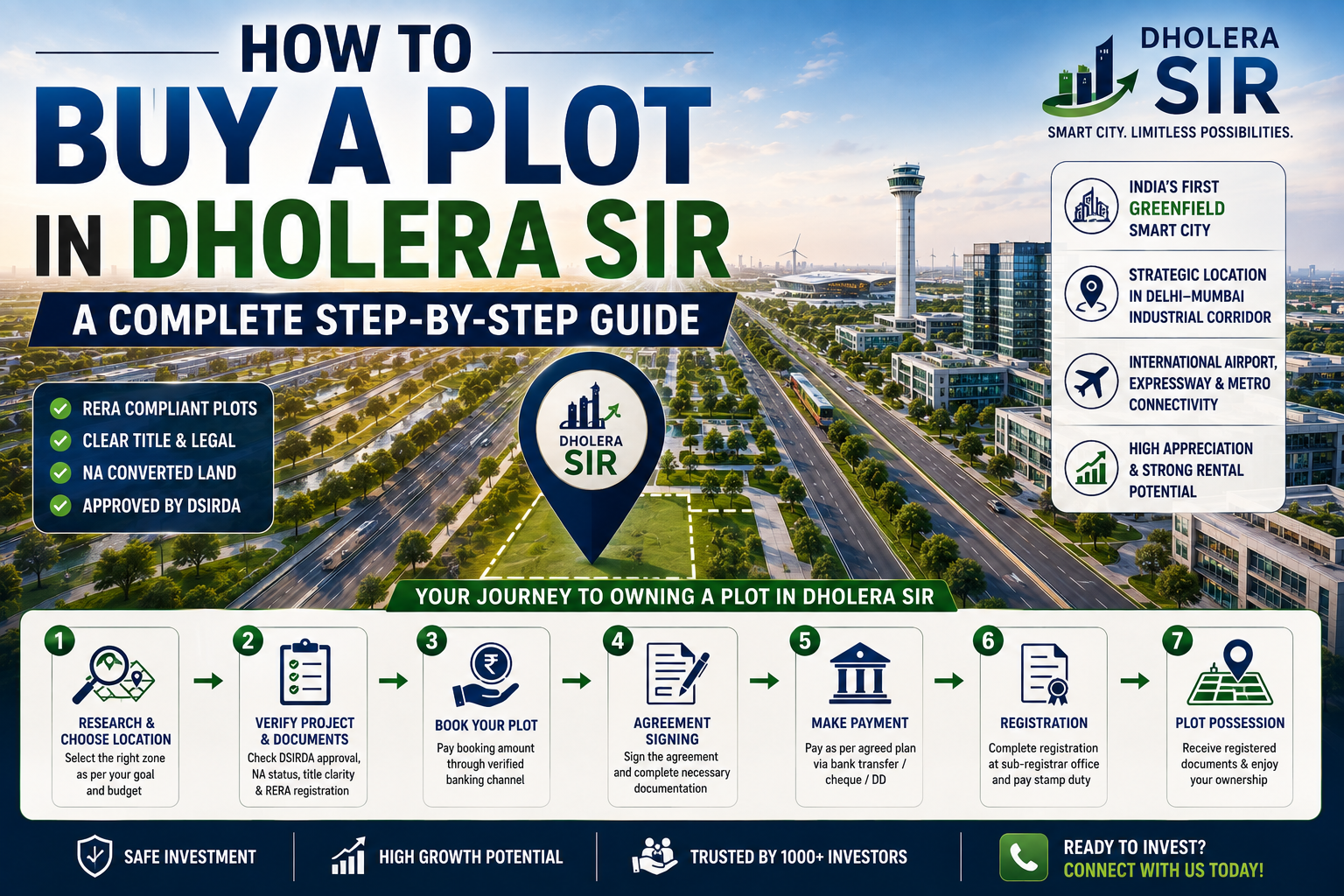
How to Buy a Plot in Dholera SIR: A Complete Step-by-Step Guide For A New Buyer
How to Buy a Plot in Dholera SIR: A Complete Step-by-Step Guide
Dholera Special Investment Region (SIR) is India's first planned greenfield smart city, developed under the Delhi–Mumbai Industrial Corridor (DMIC) and governed by the Dholera Special Investment Region Development Authority (DSIRDA). With infrastructure such as the Ahmedabad–Dholera Expressway, the upcoming international airport, and the Tata Electronics semiconductor plant now under construction nearby, interest in Dholera land has grown steadily among first-time investors, NRIs, and industrial buyers alike.
If you're considering a plot purchase in Dholera SIR, here is a clear, practical walkthrough of the process — from understanding zones to final registration.
1. Understand the Different Zones in Dholera SIR
Dholera SIR is organized under a structured master plan with distinct Town Planning (TP) schemes. Before you buy, it helps to know what each zone is meant for:
Residential zones — for building homes or long-term residential land holding
SCO (Shop-Cum-Office) / mixed-use zones — plots that allow a combination of commercial and residential use
Industrial and logistics zones — designated for manufacturing units, warehousing, and industrial operations
Commercial zones — for retail, offices, and business establishments
Choosing the right zone for your goals — whether that's building a home, running a business, or simply holding land — is the first decision to get right.
2. Set Your Budget and Purpose
Plot prices in Dholera SIR vary significantly depending on the zone, plot size, road width, and proximity to key infrastructure such as the semiconductor plant, the expressway, or the planned metro corridor. Before shortlisting properties, clarify:
Whether you're buying for personal use (building a home or office) or as a long-term land holding
Your total budget, including registration, stamp duty, and any brokerage or consulting fees
Your investment horizon — Dholera SIR is a long-term, infrastructure-driven development, and plot decisions should be made with that timeline in mind
3. Verify the Land Title and Documentation
This is the single most important step in any land purchase. Before making any payment, verify:
Title deed — confirms the seller's legal ownership of the plot
7/12 extract and revenue records — official Gujarat land records showing ownership and land classification
Encumbrance certificate — confirms the land is free of loans, disputes, or legal claims
TP scheme documents — confirms which Town Planning scheme and final plot (FP) number the land falls under
DSIRDA approvals — confirms the land use is compliant with the Dholera SIR master plan
Always work with a consultant or legal advisor who can independently verify these documents rather than relying solely on the seller's claims.
4. Confirm the Regulatory Framework
Dholera SIR is governed by DSIRDA, and land use, layout approvals, and development permissions are regulated under its master plan. If you're evaluating a project located near — but outside — the formal SIR boundary, confirm this distinction clearly with the seller, since land inside and outside the SIR boundary is governed differently. Reputable developers will be transparent about whether a project sits within the notified SIR boundary or in the surrounding influence area.
5. Visit the Site
Wherever possible, arrange a physical site visit before finalizing a purchase. A site visit helps you verify:
Actual plot location relative to TP scheme maps
Road access and width (many Dholera plots are marketed by their FP road width)
Proximity to declared infrastructure — expressway access points, the airport site, or industrial zones
General development activity in the surrounding area
If you're an NRI or unable to travel, ask your consultant for a video walkthrough and request the TP scheme map with the plot clearly marked.
6. Understand the Payment and Registration Process
1. Booking amount — a token amount to reserve the plot, usually against a booking agreement.
2. Sale agreement — outlines the full plot details, payment schedule, and terms between buyer and seller.
3. Balance payment — as per the agreed schedule, often in installments for larger transactions.
4. Registration — the sale deed is registered at the local Sub-Registrar office, and stamp duty is paid as per Gujarat state rates.
5. Mutation of records — updating revenue records to reflect the new ownership, completing the legal transfer.
7. Factor in NRI-Specific Requirements
If you're an NRI purchasing land in Dholera SIR, a few additional points apply:
Payments must be made through NRE/NRO banking channels, in compliance with FEMA regulations
A Power of Attorney (POA) may be required if you cannot be physically present for registration
PAN card is mandatory for the transaction
Work with a consultant experienced in NRI transactions to avoid documentation delays
8. Work With a Trusted Local Consultant
Because Dholera SIR is still a developing region with multiple TP schemes, zones, and ongoing infrastructure projects, working with a consultant who understands the master plan, current DSIRDA guidelines, and specific project documentation can help you avoid common pitfalls — from unclear titles to plots that don't match their advertised zone.
Final Thoughts
Buying a plot in Dholera SIR is a long-term decision tied to the region's infrastructure development timeline — including the expressway, airport, and industrial investments already underway. Taking the time to verify documentation, understand zoning, and work with a knowledgeable local team will help you make a well-informed decision.
Omana Projects works with investors, homebuyers, and NRIs looking to explore residential, SCO, and industrial plot opportunities in and around Dholera SIR, with complete transparency on documentation and project details.
Ready to explore plots in Dholera SIR? Contact Omana Projects for verified plot options and personalized guidance.