
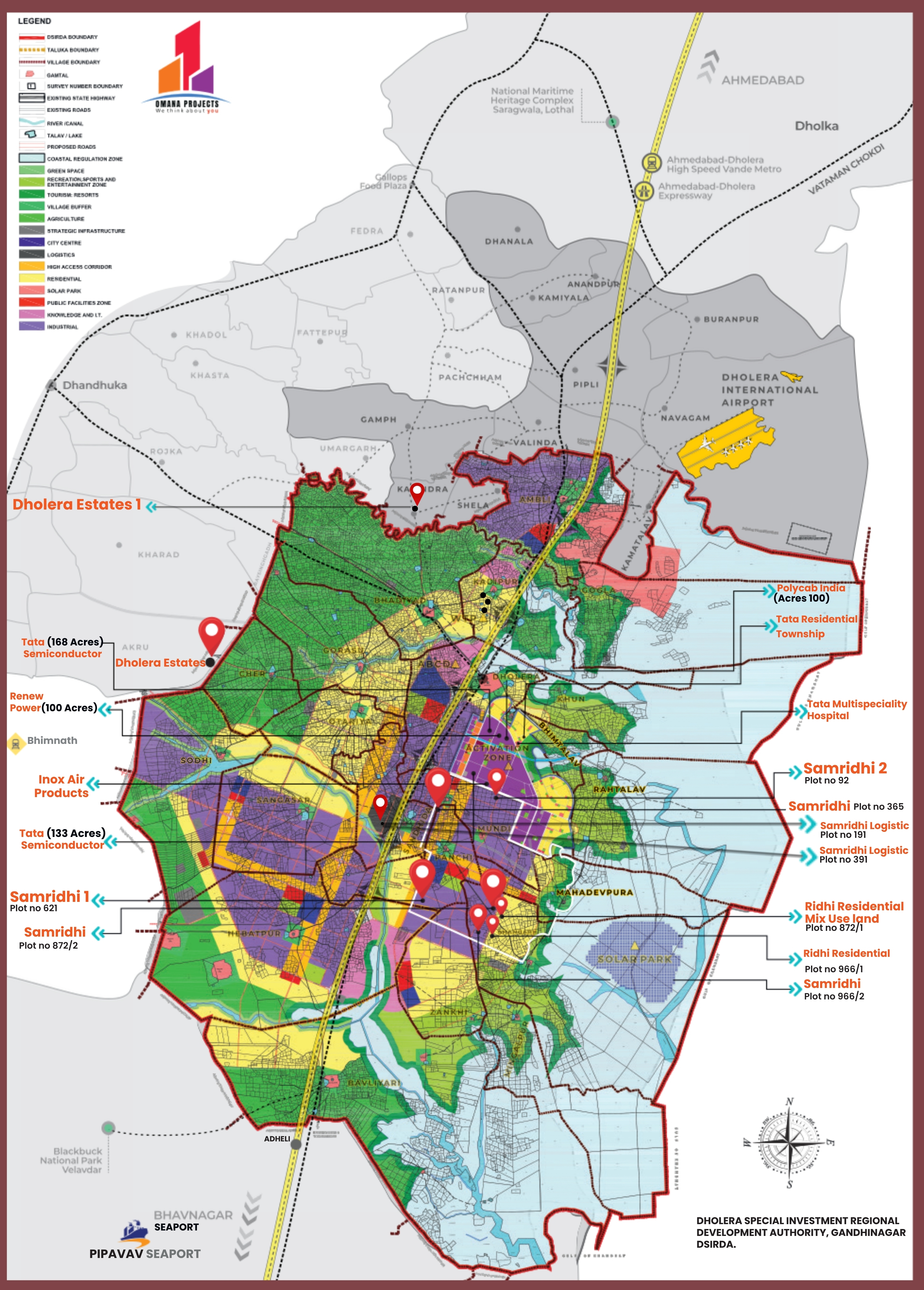
One of India's most ambitious urban and economic development initiatives is the Dholera Special Investment Region (SIR). A greenfield smart city with integrated industrial, residential, and logistics zones
Dholera SIR Master Plan Explained: Industrial, Residential & Logistics Zones
One of India's most ambitious urban and economic development initiatives is the Dholera Special Investment Region (SIR). A greenfield smart city with integrated industrial, residential, and logistics zones is intended to become a cutting-edge center for trade, manufacturing, innovation, and sustainable living. We'll examine the master plan in this in-depth blog, including how the city is zoned, what each zone comprises, the infrastructure foundation, and the implications for locals, companies, and investors.
What Is the Dholera SIR Master Plan?
The Dholera SIR master plan is a long-term urban and economic blueprint intended to direct the region's growth in the ensuing decades. Its growth strategy is planned from the ground up, in contrast to traditional cities that develop naturally. This ensures effective land use, strong infrastructure, and a smooth integration of technology, sustainability, and economic activity.
Fundamentally, the master plan divides the city into separate but related zones:
- Zones of Industry
- Zones for Residential and Mixed Use
- Hubs for Logistics and Transportation
- Encourage Civic Spaces & Infrastructure
Each zone is essential to achieving Dholera SIR's overarching goal of becoming a smart, sustainable, and globally competitive urban ecosystem.
Industrial Zones: Powering Growth and Manufacturing
1. Vision and Purpose
The core of Dholera SIR's economy is its industrial zones. These areas are strategically positioned to maximize connectivity with roads, trains, airplanes, and ports, and are intended to draw in large-scale manufacturing, high-tech industries, and export-oriented businesses.
2. Included
- The master plan's industrial zones are intended to house:
- Manufacturing of Automobiles and Auto Components
- Production of Aerospace and Defense
- Semiconductors and Electronics
- Life Sciences & Pharmaceuticals
- Green technology and heavy engineering
These industries are ranked according to both global demand trends and India's national growth objectives.
3. Plug-and-Play Infrastructure
One of the biggest advantages of Dholera’s industrial zones is ready infrastructure:
- Pre-laid utilities (power, water, gas)
- High-capacity digital connectivity
- Waste treatment facilities
- Common logistics and storage centers
This reduces lead time for businesses to begin operations and enhances ease of doing business.
Residential Zones: Urban Living Meets Smart Design
1. Planned Neighborhoods
Rather than haphazard residential pockets, Dholera’s master plan envisages well-structured living zones with modern amenities. These neighborhoods are designed for:
- Comfortable housing
- Green public spaces
- Schools, hospitals, and community centers
- Recreational and retail areas
2. Smart Living Features
Residential areas in Dholera aren’t just places to live — they are built with smart city features:
- Integrated digital services (e-governance, utility tracking)
- Sensor-based waste collection
- Smart street lighting
- Sustainable water and energy systems
Residents can expect a level of comfort and efficiency that compares with the world’s leading smart cities.
3. Mixed-Use Development
To reduce commute times and improve convenience, many residential zones incorporate mixed-use elements — combining housing with commercial activities such as retail, coworking spaces, and services.
Logistics & Transportation Zones: Connected for Commerce
1. Strategic Connectivity
Dholera SIR’s master plan places heavy emphasis on logistics, recognizing that supply chain efficiency is essential to industrial competitiveness. The Dholera logistics plots zones are strategically positioned near:
- Expressways
- Freight Corridors
- Rail Hubs
- International Airport
This design significantly improves cargo movement within the region and to international markets.
2. Integrated Transport Hubs
The plan includes multi-modal logistics parks—facilities where goods can seamlessly switch between rail, road, and air transport. These parks are designed with features like
- Cold storage
- Warehousing
- Bonded logistics zones
- facilitation centers
3. Last-Mile Connectivity
Dholera’s transport network isn’t just about long-haul freight. The master plan includes:
- Urban transit systems (metro/rapid transit)
- Inter-town shuttles
- Pedestrian-friendly corridors
- Cycling infrastructure
These features ensure that the city is not only industrially efficient but also human-centered.
Support Infrastructure & Civic Spaces
No master plan can succeed without robust civic and utility infrastructure. Dholera SIR’s blueprint integrates:
- Smart Grids & Renewable Energy
- Water Treatment and Recycling
- Advanced Waste Management
- Green Spaces & Urban Parks
- Educational, Healthcare & Recreational Facilities
These components are designed to make Dholera a self-sustaining, resilient city capable of thriving in the 21st century.
Why the Master Plan Matters
Dholera’s master plan is more than lines on a map—it’s a strategic vision that:
- Ensures economic resilience
- Attracts global investment
- Creates employment opportunities
- Enhances quality of life
- Promotes sustainable urban growth
The phased implementation of this plan means that as infrastructure rolls out, corresponding economic and residential growth follows in a coordinated manner.
Frequently Asked Questions (FAQs)
1. What makes the Dholera master plan unique?
Unlike organic city growth models, Dholera’s master plan is intentionally and holistically designed. It integrates industrial, residential, logistics, and civic zones from the outset, ensuring efficient land use, smart infrastructure, and sustainability.
2. How are industrial and residential areas separated?
Industrial zones are located on the periphery and near major transport infrastructure to reduce congestion and environmental impact, while residential and mixed-use zones are planned closer to civic amenities and green spaces for better quality of life.
3. Will there be public transportation in Dholera?
Yes. The master plan includes urban transit systems, such as metro or rapid transport options, along with last-mile connectivity solutions like buses and shuttles for intra-city movement.
4. Can businesses start operations immediately?
Many industrial plots in the initial activation areas have plug-and-play infrastructure, meaning utilities and connectivity are pre-established, which significantly shortens the time to launch operations.
5. Is Dholera SIR environmentally friendly?
Sustainability is a core principle. The master plan includes renewable energy integration, water recycling, efficient waste management, and green public spaces to minimize environmental footprint.
6. Who oversees the master plan implementation?
The authority responsible for planning and implementation is the Dholera Special Investment Regional Development Authority (DSIRDA), working with central and state government agencies and private partners.
Conclusion
The Dholera SIR master plan is a bold step toward building a future-ready city — one that balances economic opportunity with quality living and sustainable design. By thoughtfully zoning the region into industrial, residential, and logistics sectors, Dholera is setting a global benchmark for smart urban development.
If you’re a business looking to expand, an investor seeking long-term growth prospects, or a family envisioning a modern urban lifestyle, Dholera SIR’s master plan offers something transformative for everyone.
For More Information Contact Us or call us +91 92171 04219