
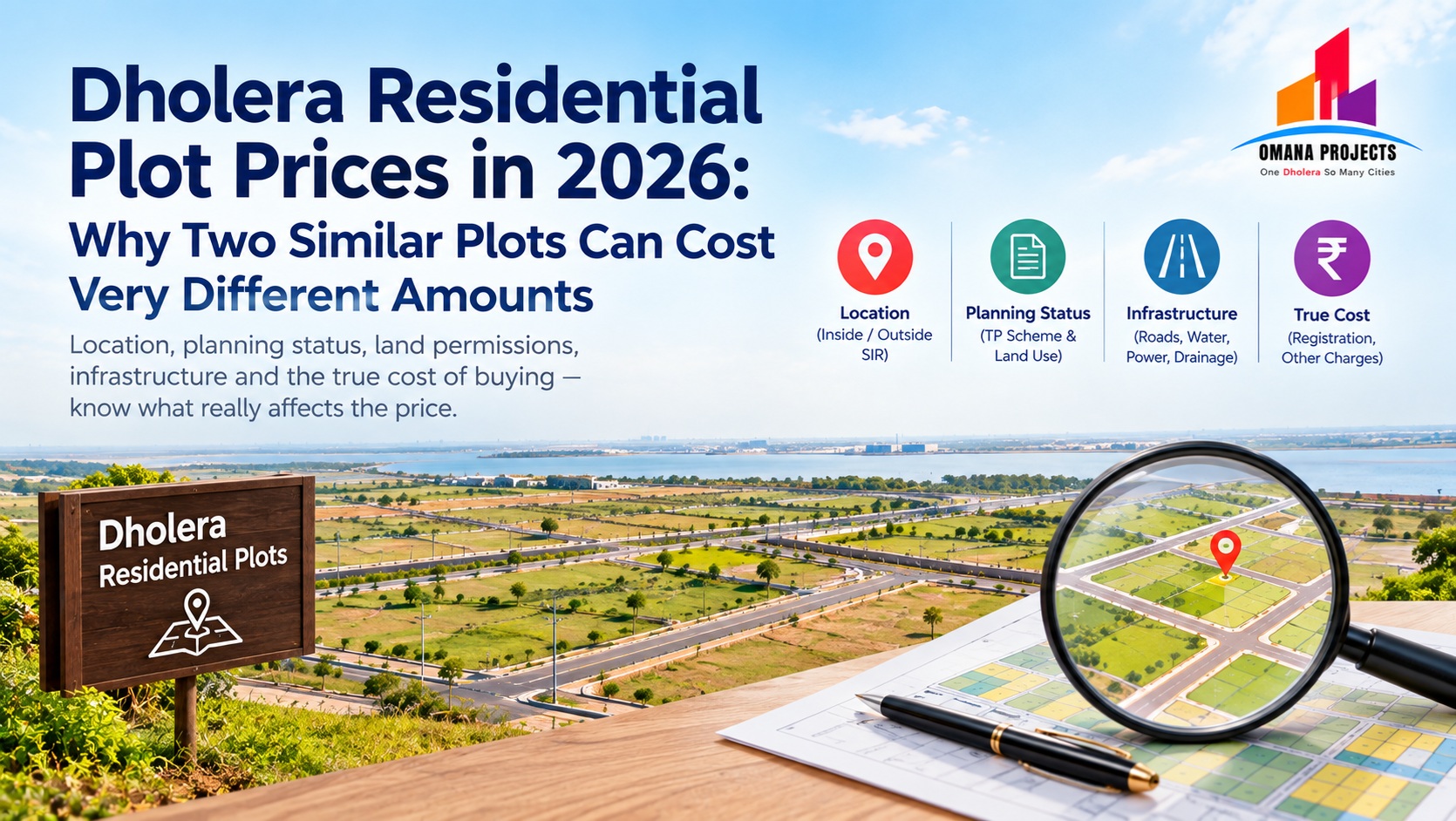
Why do similar Dholera residential plots cost different amounts? Compare location, TP scheme, infrastructure, total cost and documents before you decide
Dholera Residential Plot Prices in 2026: Why Two Similar Plots Can Cost Very Different Amounts
If you search for residential plots in Dholera, you will quickly notice that advertised prices vary widely. Some plots are marketed as affordable entry points. Others ask for a much higher amount because of where they sit within the planned development area.
For a first-time buyer, this is confusing. Why does one plot cost far more than another when both are described as Dholera properties?
The answer is rarely one single factor. In most cases, the difference comes from location, planning status, land permissions, infrastructure and the true cost of buying. This guide explains each factor in plain language, so you can compare plots on facts rather than on headline rates.
Is There One Dholera Residential Plot Price?
No. There is no single price that applies to every Dholera residential plot. The rate per square yard depends on where the plot is, how it is classified, what documents support it and how much of the surrounding infrastructure is already in place.
A useful starting point is to treat any advertised price as an opening number, not a market rate. Ask what the number includes, what it leaves out and which official records support the claim. Prices are also not fixed over time, so always confirm the current figure directly with the seller before you rely on it.
Inside Dholera SIR vs Outside Dholera SIR
The first factor is whether a plot lies inside the officially notified Dholera Special Investment Region (SIR).
- Inside the SIR: the plot falls under the applicable planning framework and designated development areas. Land use, permitted construction and infrastructure follow the region’s plans.
- Outside the SIR: the plot may belong to a nearby village or a separate residential project governed by different authorities and rules.
Neither category should be judged by price alone. A plot outside the boundary can be a sensible choice for some buyers, and a plot inside the boundary can still be a poor choice if its documents are weak. What matters is that you know which category your plot belongs to and what approvals and development conditions apply to it.
Ask the seller to state the location in writing, and verify it against the official records rather than a marketing brochure.
Town Planning Scheme and Final Plot Details
Dholera SIR is organised into multiple Town Planning (TP) schemes. A plot’s TP location can affect its permitted use, how infrastructure is planned around it and how it is positioned in the market.
Because of this, two plots of similar size can carry different prices simply because they sit in different TP schemes. Our guide to TP zones in Dholera and how they fit different budgets explains how the schemes compare.
Before you compare any prices, collect these details for each plot:
- The survey number
- The final plot number, where applicable
- The TP scheme it belongs to
- The official land-use classification
A developer’s marketing map should never be the only source you use to establish a plot’s location. Maps drawn for brochures are meant to attract attention, not to serve as legal proof. For a clear explanation of how survey numbers and final plot numbers differ, read our buyer’s guide on survey number vs final plot number in Dholera.
Infrastructure Readiness: Built vs Proposed
Two plots of the same size can have very different values because one has practical access to developed roads and utilities, while the other depends on infrastructure that is still on paper.
Look at these factors for every plot you compare:
- Existing approach roads, and their width
- Water and electricity access
- Drainage and other utility provisions
- Surrounding development and how occupied it is
- Distance from employment centres, services and the Ahmedabad–Dholera Expressway
The most important habit here is to separate completed infrastructure from proposed infrastructure. A road that is already built and in use is a fact. A road shown in a plan is an intention. Prices that already assume future infrastructure may leave little room for further gains if the work is delayed.
The official Dholera SIR website describes the Activation Area as the first phase, covering 22.54 sq km, with trunk infrastructure developed and an internal road network of about 72 km. Check what exists around your specific plot rather than assuming the same level of readiness everywhere.
Plot Size, Shape and Frontage
Plot size affects the total price, but it can also affect the rate per square yard. Smaller plots sometimes carry a higher rate per square yard because they are easier to buy and build on. Larger plots may have a lower rate but need a bigger budget.
Shape and frontage matter too. Consider:
- Whether the plot is regular in shape or awkward
- The width of the road it faces
- Whether it is a corner plot
- Whether the orientation suits your plans
A plot with a wider road in front, a regular shape and a corner position may cost more than a similar plot on a narrow internal lane. That difference is often reasonable. Ask yourself whether the extra cost is something you will actually use.
Total Purchase Cost, Not Just the Rate per Square Yard
An advertised rate per square yard does not represent the full cost of ownership. Ask for a written breakdown that includes:
- The base sale price
- Stamp duty and registration charges
- Development or maintenance fees, if any
- Legal verification costs
- Any other charges the seller expects you to pay
In Gujarat, stamp duty is commonly stated as 4.9% of the property value, along with a registration fee of 1%. These are calculated on the higher of the agreement value or the government’s Jantri (guideline) rate, which you can check on the official GARVI portal at garvi.gujarat.gov.in. Rules and rates can change, so confirm the current position with the Sub-Registrar or the portal before you budget.
Here is a simple illustration. Suppose a plot is agreed at ₹50 lakh and the Jantri value is lower:
- Stamp duty at 4.9%: ₹2,45,000
- Registration fee at 1%: ₹50,000
- Combined statutory charges: ₹2,95,000
This is an illustration of the method, not a price for any specific plot. Add legal fees and other costs on top. A plot that looks cheaper may end up costing about the same, or more, once every item is counted.
For the full step-by-step process, from sale agreement to mutation, see our Dholera plot registration and stamp duty guide.
Documentation and Ownership
A properly documented property is far easier to evaluate than one with incomplete records. A low price can sometimes be a signal of missing paperwork, so do not treat it only as a bargain.
Verify these documents with an independent legal professional:
- The title chain, showing how ownership has passed over time
- Revenue records for the land
- Encumbrance records, to confirm there are no loans or disputes
- Layout permissions
- Relevant planning documents
- Land-use and NA (non-agricultural) status, where applicable
Government records are the best reference. Gujarat’s land records portals and the GARVI system allow certain checks online, though what you can verify will depend on the plot. Professional legal verification is particularly important when you are buying land in a developing region, because the cost of a mistake is far higher than the cost of a check.
Intended Use: House or Long-Term Holding?
The right price depends on what you plan to do with the plot. Be honest about your purpose before you compare options.
- Building a home within about five years: you will care more about road access, utilities, nearby services and whether construction is permitted soon. Paying more for a plot that is ready to use can make sense.
- Holding land for the long term: you may accept less infrastructure today, but you should be comfortable waiting and should check the plot’s position in the planning framework.
A plot that suits one buyer can be wrong for another, even at the same price. Our update, Is Dholera Ready for a Home in 2026, can help you judge how close the region is to everyday living.
How to Compare Dholera Plot Prices Step by Step
Create a simple comparison sheet for at least three properties. Use the same headings for each, so you are comparing like with like.
- Location, including whether it is inside or outside the SIR
- TP scheme, survey number and final plot number
- Land-use category
- Plot size, shape and road frontage
- Total cost, including statutory charges
- Infrastructure status, marked as built or proposed
- Document readiness and registration readiness
- Distance to your workplace, school or other essential places
Fill in the sheet from written answers and official records, not from phone calls alone. Then rank the properties on value for your purpose, not on price alone.
Where possible, compare actual registered transactions in the same area rather than relying only on advertised rates. A registered deed shows what a buyer actually paid, while an advertisement shows what a seller hopes to receive.
Common Mistakes When Comparing Dholera Plot Prices
- Choosing the lowest rate without checking documents
- Treating proposed infrastructure as if it already exists
- Ignoring stamp duty, registration and other costs
- Relying on a brochure map instead of survey and plot details
- Comparing plots of different land-use categories as if they were the same
- Buying on urgency, because of a limited-time offer
Each of these mistakes is avoidable, and avoiding them costs far less than fixing them later.
Frequently Asked Questions
Q.1 What is the price of a residential plot in Dholera?
Ans. There is no single price. It varies with location, TP scheme, infrastructure, size, land-use status and documents. Confirm the current price directly and compare several properties.
Q.2 Why are some Dholera plots much cheaper than others?
Ans. Differences usually come from location inside or outside the SIR, TP scheme, infrastructure readiness, plot size and the state of documentation. A lower price is not a flaw in itself, but it should be explained.
Q.3 Is the price per square yard the final cost?
Ans. No. Add stamp duty, registration charges, legal verification and any other fees the seller expects you to pay.
Q.4 What is the stamp duty for a plot in Gujarat?
Ans. Stamp duty is commonly stated as 4.9% with a 1% registration fee, calculated on the higher of the agreement value or the Jantri rate. Verify current rates on the GARVI portal at garvi.gujarat.gov.in.
Q.5 Should I compare plots inside and outside the SIR on price alone?
Ans. No. Each follows different planning and approval conditions, so compare them on legal status, infrastructure and your purpose.
Q.6 How many properties should I compare?
Ans. At least three, using the same headings, so the comparison is fair.
Final Thoughts
There is no single Dholera residential plot price that applies to every location. The right question is not whether a plot is cheap or expensive. It is whether the price is justified by its legal status, location, infrastructure and suitability for you.
Before you buy, verify current prices directly, check every document with an independent professional and compare registered transactions where available instead of relying entirely on advertised rates. A careful comparison takes a little time, but it protects your money for years.
Want help comparing Dholera residential plots with clear, verified information? Call us +91 92171 04219 or msg on whatsapp.